gbs
gbs March 5, 2024
 March 5, 2024
Luís Figo
March 5, 2024
Luís Figo

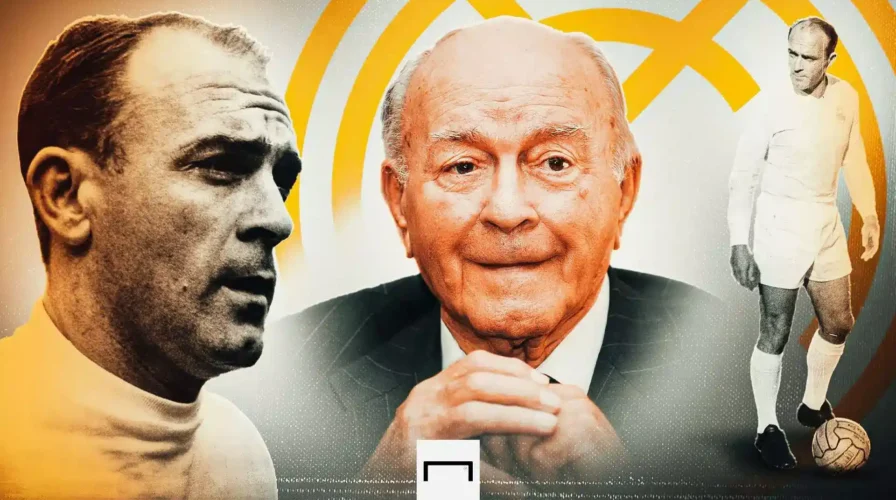
Alfredo Di Stéfano, often hailed as one of the greatest footballers of all time, was an extraordinary player known for his versatility, skill, and unmatched ability to dominate a match. Born on July 4, 1926, in Buenos Aires, Argentina, Di Stéfano played primarily as a forward but was renowned for his ability to perform in almost any position on the field. He is best remembered for his achievements with Real Madrid, where he became a cornerstone of the club’s dominance in European football during the 1950s and early 1960s.
Career Highlights
- Club Career:
- River Plate (1945–1949): Di Stéfano began his career with River Plate in Argentina, helping them win the Argentine Primera División title. Known as “La Saeta Rubia” (The Blond Arrow), his talent quickly shone through.
- Millonarios (1949–1953): Due to a players’ strike in Argentina, Di Stéfano moved to Colombia to play for Millonarios, where he became a sensation, scoring freely and winning four Colombian league titles.
- Real Madrid (1953–1964): Di Stéfano joined Real Madrid in 1953 after a transfer battle between Madrid and Barcelona. He would go on to become one of Madrid’s greatest legends, winning five consecutive European Cups (now the UEFA Champions League) from 1956 to 1960 and eight La Liga titles. His performances, often involving extraordinary skill, intelligence, and work rate, were instrumental in establishing Real Madrid as a powerhouse.
- Espanyol (1964–1966): Di Stéfano concluded his career with a brief stint at Espanyol in Spain, before retiring at the age of 40.
- International Career:
- Di Stéfano had the unique experience of representing three different national teams—Argentina, Colombia (in unofficial games), and Spain—due to different circumstances and eligibility rules at the time.
- Argentina (1947): Di Stéfano played just six matches for Argentina, scoring six goals and winning the South American Championship (now Copa América) in 1947.
- Spain (1957–1961): After becoming a Spanish citizen, Di Stéfano represented Spain, scoring 23 goals in 31 appearances. Unfortunately, he was unable to compete in a World Cup due to Spain’s failure to qualify in 1958 and an injury before the 1962 World Cup.
- Playing Style:
- Di Stéfano was known for his exceptional versatility, intelligence, and relentless energy. While he started as a forward, he frequently moved all over the pitch, contributing to both attack and defense, and essentially acting as a playmaker.
- His ability to score, assist, and control the pace of the game made him a unique player and a complete footballer, often described as “a player ahead of his time.”
- His style laid the foundation for modern football roles, combining skills that were typically split among different positions.
- Accolades:
- Di Stéfano won two Ballon d’Or awards (1957 and 1959), with multiple runner-up finishes, and was named to several all-time lists and teams, including the FIFA 100.
- He scored over 300 goals for Real Madrid and is the club’s second-highest goal-scorer in the European Cup.
- His crowning achievement with Real Madrid was the five consecutive European Cups, during which he scored in each final, an unparalleled feat.
- Post-Playing Career
- Di Stéfano transitioned into management, coaching several teams, including Real Madrid. While he did not achieve similar success as a manager, his influence on the game remained profound.
- In 2000, Real Madrid honored him by naming him Honorary President, and he became a symbolic figure for the club, representing its values and history.
Legacy and Impact
Alfredo Di Stéfano’s influence on Real Madrid and global football is immense. He is often credited with transforming Real Madrid into a dominant European force and is celebrated as one of the most complete players in football history. His influence extended beyond his goal-scoring ability, as he inspired generations of players to adopt a more holistic, multi-positional approach to the game.
In 2014, Di Stéfano passed away, but his legacy remains, not only as a Real Madrid icon but as one of football’s true pioneers and a player whose skills transcended his era.
 March 5, 2024
Luís Figo
March 5, 2024
Diego Maradona
March 5, 2024
Luís Figo
March 5, 2024
Diego Maradona

Popular Legends



Categories

Football live score and World Most Famous Players in Football History!